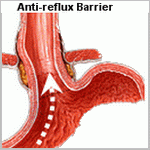
The lower esophageal sphincter is a physiological sphincter acting like a valve. It is a ring of smooth muscle fibers at the junction of the esophagus and stomach.
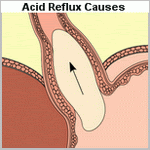
As the stomach generates strong acids and enzymes to aid in food digestion; it is protected at the same time by virtue of its inner lining which has several mechanisms to resist the effect of gastric juice on itself. On the other hand the mucosa of the esophagus does not have these protective mechanisms. Fortunately the esophagus is normally protected from these acids by this one-way valve mechanism at its junction with the stomach i.e. lower esophageal sphincter (LES), which prevents gastric juice from flowing back into the esophagus.
During peristalsis, the LES allows the food bolus to pass into the stomach. It prevents chyme (a mixture of bolus, stomach acid, and digestive enzymes) from returning up the esophagus. The LES is aided in the task of keeping the flow of materials in one direction by external supportive muscle fibers derived from the diaphragm.
Contraction of smooth muscle fibers of the lower esophageal sphincter is controlled by many factors, of which the adrenergic receptors are of utmost importance.
A receptor is a molecule on the surface of the smooth muscle cell that recognizes and binds with specific molecules, producing some effect in the cell. The cell is called the effector as it performs the action dictated by a signal released following stimulation of the specified receptor.
The term adrenergic means having physiological effects similar to those of epinephrine, a hormone and neurotransmitter released at the nerve endings in contact with smooth muscle fibers.
Receptors are named after the action of epinephrine, the alternative name for adrenaline. Alpha receptors, which are stimulated by norepinephrine and blocked by agents such as phenoxybenzamine, produce contraction of the smooth muscles of the sphincter. Beta receptors, which are stimulated by epinephrine and blocked by agents such as propranolol, produce smooth muscle relaxation.
The term adrenergic is also used for drugs, which have effects similar to, or the same as, epinephrine (adrenaline). Adrenergic drugs that stimulate a response are called (agonists) and those that inhibit a response called (antagonists).
Accordingly, Alpha Adrenergic Agonists produce contraction of the lower esophageal sphincter and Beta Adrenergic Agonists are associated with relaxation of the sphincter and trigger reflux.
On the contrary, Alpha Adrenergic Antagonists produce sphincter relaxation and Beta Adrenergic Antagonists increase lower esophageal sphincter pressure.
Alpha blockers and beta-agonists are directly related to relaxation of the LES and acid reflux.
Alpha blockers ( alpha-adrenergic blocking agents) constitute a variety of drugs which block alpha-adrenergic receptors in arteries and smooth muscles.
These drugs may be used to treat:
benign prostatic hyperplasia (BPH)
high blood pressure (hypertension).
symptoms of non inflammatory chronic pelvic pain syndrome.
Examples include:
Doxazosin (Cardura)
Prazosin (Minipress)
Phenoxybenzamine
Phentolamine (Regitine)
Tamsulosin (Flomaxtra/Flomax)
Alfuzosin (Uroxatral)
Terazosin (Hytrin)
Beta adrenergic receptor agonists are a class of drugs used to treat asthma and other pulmonary disease states.
They act on the beta-adrenergic receptor, thereby causing smooth muscle relaxation resulting in dilation of bronchial passages, vasodilation in muscle and liver, relaxation of uterine muscle and release of insulin. All beta agonists are available in inhaler form (either metered-dose inhalers, which aerosolize the drug, or dry powder which can be breathed in).
In addition, several of these medications are available in intravenous forms including both salbutamol and terbutaline. It can be used in this form in severe cases of asthma, but more commonly it is used to suppress premature labor because it also relaxes uterine muscle, thereby inhibiting contractions.
Examples include:
salbutamol (albuterol)
levalbuterol
terbutaline
pirbuterol
procaterol
metaproterenol
fenoterol
bitolterol mesylate
In patients with acid reflux disease, drug history should be reviewed to detect any of these drugs associated with sphincter relaxation. The physician, would evaluate the medical background and reconsider all medications given.
Sunday, October 7, 2007
 Adrenergic drugs and acid reflux

Thursday, September 27, 2007
The role of saliva in acid reflux relief
What about chewing gums for acid reflux relief?
The importance of saliva in acid reflux relief can be predicted by considering a scenario where an individual is about to vomit. Vomit contains gastric substances which are extremely acidic and injurious. A protective reflex occurs before the individual prepares to vomit. Signals are sent from the brain to the salivary glands via the involuntary nervous system to cause increased saliva secretion, even before vomiting occurs. Thus, when vomiting does occur, there is already saliva available for acting to minimize the acidity and thus prevent tissue destruction.
Saliva is formed mainly in the major glands of the parotid, submandibular, and sublingual, as well as minor glands. The constituents of saliva are mediators of its various functions and effects in relation to acid reflux relief. As saliva is a viscous liquid mainly composed of water and containing mucin; one of its important functions is acting as a lubricant for the passage of food into the esophagus, moistening food and helping to create a food bolus, so it can be swallowed easily. Diminished salivary production deprives the swallowed food bolus of its water content and the lubricant effect of mucin, it would thus be irritating to the esophageal lining.
Saliva contains all the ions usually present in body fluids, and of these, bicarbonate ions which play a major role in determining the pH and buffering capacity of saliva. The primary salivary buffer is composed of bicarbonate (HCO3-). Bicarbonate is excreted through the duct system by means of an active transport mechanism. Salivary bicarbonate can help protect the esophgus against attack from refluxed acid produced by the stomach. This buffer system forms the first line of defense against acidic challenges, a salivary function of utmost importance in esophageal clearance and acid reflux relief.
Salivary responses to chewing and taste stimuli are innate. Salivary flow increases during eating. The physical action of chewing stimulates nerve endings in the tissues around the teeth. Flavorful substances stimulate taste buds. Both of these stimuli are potent initiators of salivary flow. Signals from nerve endings in the mouth evoke salivation by exciting the salivary centers in the brain stem. Salivary secretion is controlled by the autonomic nervous system. The importance of chewing and avoiding medications that affect the involuntary nervous system is thus quite clear for acid reflux relief. Smoking is also a known factor in the causation of dry mouth and should be stopped.
Secretion of the salivary glands is 1-1.5 liters daily. When salivary flow is too low, dry mouth (xerostomia) may result. Here, normal oral functions such as chewing and swallowing can be uncomfortable and difficult to perform and acid reflux is aggravated.
Emotional disturbances affect the rate of salivary secretion leading to xerostomia. A lowered rate of flow has been noted in patients suffering from depression. However, most xerostomia is due to medications used in the management of these problems. Again, these factors should be considered for proper management of acid reflux.

