Once GERD is suspected or thought to be responsible for asthma symptoms, treatment may be with either prolonged PPI (proton pump inhibitor) therapy or anti reflux surgery. A 3- to 6-month trial of high-dose PPI therapy [twice a day (b.i.d.) or three times a day (t.i.d.) dosing] may help confirm (by virtue of symptom resolution) that GERD is partly or completely responsible for the asthma symptoms. The persistence of symptoms despite PPI treatment, however, does not necessarily rule out GERD as a potential contributor.
Based on reported observations, relief of asthma symptoms can be anticipated for 25% to 50% of patients with GERD asthma treated with anti reflux medications.
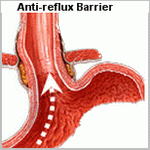
Fewer than 15%, however, can be expected to have objective improvements in their pulmonary function. The reason for this apparent paradox may be that most studies employed relatively short courses of anti reflux therapy (less than 3 months). This time period may have been sufficient for symptomatic improvement but insufficient for recovery of pulmonary function. The chances of success with medical treatment are likely directly related to the extent of GERD elimination. The conflicting findings of reports of anti reflux therapy may well be to the result of inadequate control of GERD in some studies. The literature indicates that anti reflux surgery improves asthma symptoms in nearly 90% of children and 70% of adults with asthma and GERD. Improvements in pulmonary function were demonstrated in around one third of patients. Comparison of the results of uncontrolled studies of each form of therapy and the evidence from the two randomized controlled trials of medical versus surgical therapy indicate that fundoplication is the most effective therapy for GERD asthma. The superiority of the surgical anti reflux barrier over medical therapy is probably most noticeable in the supine posture, which corresponds with the period of acid breakthrough with PPI therapy and is the time in the circadian cycle when asthma symptoms and peak expiratory flow rates are at their worst.
It is also important to realize that, in asthmatic patients with a non reflux induced motility abnormality of the esophageal body, performing an anti reflux operation may not prevent the aspiration of orally regurgitated, swallowed liquid or food. This can result in asthma symptoms and airway irritation that may elicit an asthmatic reaction. This factor may explain why surgical results appear to be better in children than adults, because disturbance of esophageal body motility is more likely in adult patients.
Thursday, March 20, 2008
 GERD Asthma Treatment

Monday, March 17, 2008
GERD Asthma
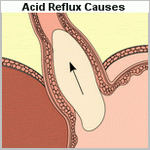
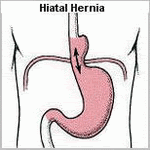
Two mechanisms have been proposed as the pathogenesis of GERD asthma. The first, the so-called reflux theory, maintains that asthma is the result of the aspiration of gastric contents. The second or reflex theory maintains that vagally mediated bronchoconstriction follows acidification of the lower esophagus. The evidence supporting a reflux mechanism is fivefold. First, clinical studies have documented a strong correlation between idiopathic pulmonary fibrosis and hiatal hernia. The presence of GERD was shown to be highly associated with several pulmonary diseases, not only asthma, in recent studies. Second, pathologic acid exposure in the proximal esophagus is often identified in patients with asthma and reflux disease. Third, scintigraphic studies have shown aspiration of ingested radioisotope in some patients with reflux and respiratory symptoms. Fourth, simultaneous tracheal and esophageal pH monitoring in patients with reflux disease has documented tracheal acidification in concert with esophageal acidification. Finally, animal studies have shown that tracheal instillation of hydrochloric acid profoundly increases airways resistance.
A reflex mechanism is primarily supported by the fact that bronchoconstriction occurs following the infusion of acid into the lower esophagus. This can be explained by the common embryologic origin of the tracheoesophageal tract and its shared vagal innervation. Second, patients with asthma and pathologic distal esophageal acid exposure but normal proximal esophageal acid exposure may experience an improvement in their asthma after antireflux therapy.
The primary challenge in implementing treatment for reflux-associated asthma lies in establishing the diagnosis. In patients with predominantly typical reflux symptoms and secondary respiratory complaints, the diagnosis may be straightforward. However, in a substantial number of patients with GERD asthma, the respiratory symptoms dominate the clinical scenario. GE reflux in these patients is often silent and is uncovered only when investigation is initiated. A high index of suspicion is required, notably in patients with poorly controlled asthma despite appropriate bronchodilator therapy. Supportive evidence for the diagnosis can be gleaned from endoscopy and stationary esophageal manometry. Endoscopy may show erosive esophagitis or Barrett's esophagus. Manometry may indicate a hypotensive LES or ineffective body motility, defined by 30% or more contractions in the distal esophagus of less than 30 mm Hg in amplitude.
The gold standard for the diagnosis of GERD asthma is ambulatory dual-probe pH monitoring. One probe is positioned in the distal esophagus and the other at a more proximal location. Sites for proximal probe placement have included the trachea, pharynx, and proximal esophagus. Most authorities would agree that the proximal esophagus is the preferred site for proximal probe placement. Although ambulatory esophageal pH monitoring allows a direct correlation between esophageal acidification and respiratory symptoms, the chronologic relationship between reflux events and bronchoconstriction is complex.

